
Víctor de Currea-Lugo | March 1, 2026
I do not believe in the idea that wars are “unique, unrepeatable, and exceptional.” On the contrary, wars tend to resemble one another. From that perspective, I reject the particularism
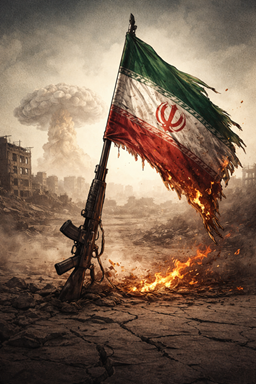
I have encountered in many conflict zones. Yet there is one category worth defending: the idea of an existential war, especially after the assassination of Ayatollah Khamenei and numerous political and military leaders. This was not merely an assassination; it was a decapitation strike against the Iranian state.
Over the years, I have interviewed Kurds, Kashmiris, Palestinian resistance fighters, Syrian combatants, Iraqi militiamen, and Taliban members in Afghanistan. In almost every case, there is a tendency to believe that one’s own war is unique and incomparable.
For obvious reasons, I will not dwell on the fact that some analysts in Colombia maintain a similar argument, convinced that we are the center of the world, to the point that someone once proposed in Madrid that Colombia deserved a special form of International Humanitarian Law because our war was supposedly exceptional.
More broadly, there exists a remarkably clumsy academic obsession with inventing categories of war. Analysts speak of “hybrid warfare,” even though all wars are hybrid. Others refer to “low-intensity conflicts,” as if intensity could be objectively measured.
Some institutions, such as Uppsala University, classify armed conflicts according to numerical thresholds: a thousand deaths qualify as a major conflict; 999 apparently do not. Likewise, theories of “generations of warfare” function only when applied to modern state armies and collapse when confronted with earlier historical conflicts in which the state, as we understand it today, did not exist.
Beyond these academic exercises, however, two categories remain analytically useful: wars that reshape geopolitics, like Iran’s current conflicts, and existential wars. In Iran’s case, both converge, highlighting how these conflicts influence global power balances and regional stability.
Wars that reshape geopolitics
Geopolitical wars are those whose dynamics, actors, and consequences significantly alter the course of world politics. Understanding these wars can inspire the audience to recognize their importance. The Second World War is an obvious example. Vietnam is another. Yet many wars, however brutal or unjust, remain marginal to global attention.
Consider the wars in Congo. Who truly pays attention to Congo when those conflicts are persistently framed as cultural or tribal rather than socioeconomic? Who genuinely paid attention to the genocide in Darfur, simplified into a supposed conflict between Arabs and Africans? When I was there, I discovered that everyone spoke Arabic and that the racial categories imposed from outside collapsed upon contact with reality.
Which wars actually keep the world awake at night? Ukraine undoubtedly does. A hypothetical military confrontation between China and Taiwan would as well. And now, whatever unfolds between Iran and Israel. One may also ask whether the genocide in Palestine produced any genuine rupture in global geopolitics or merely confirmed the horrifying status quo already in place.
Existential wars
There is another category worth considering: wars in which the very existence of a people is perceived to be at stake. Hamas and other Palestinian resistance groups operate within such a framework because survival itself appears to be on the table.
The Rohingya uprising against Myanmar’s military regime was similarly framed as a struggle for survival, carried out against a government applauded by sectors of civil society and even by a Nobel Peace Prize laureate. Recognizing these wars can deepen the audience’s empathy and sense of urgency about collective survival.
We might also recall the Syrian Kurdish fight against the Islamic State, the Battle of Stalingrad, or the Jewish resistance in the Warsaw Ghetto. Genocide alone does not define existential wars. Equally important is the symbolic moment in which a collective identity believes it has reached its final limit.
Iran represents such a collective entity. Built over thousands of years, from Persepolis to the present, it has woven together Shi’a Islam, Iranian nationalism, and Persian cultural memory into a powerful political narrative. Iran contains Kurds, Baluch regions, Arab populations, and even thousands of Jews. Yet a dominant sense of unity persists, especially when external threats emerge.
For more than two decades, Iran has been accused of pursuing nuclear weapons. Those accusations remain unproven. Despite the presence of a large proportion of the world’s nuclear inspectors searching for evidence that never appears, attention rarely turns toward places where nuclear weapons are openly acknowledged.
Israel has carried out assassinations of Iranian nuclear scientists and covert operations inside Iranian territory involving intelligence agencies such as the CIA and Mossad. Previous confrontations, including last year’s limited but intense Twelve-Day War, differ fundamentally from the present situation.
Iran remains a signatory to the Nuclear Non-Proliferation Treaty and therefore retains the legal right to develop nuclear energy for peaceful purposes. Whatever criticisms may be made of Tehran, operating outside international law is not one of them.
Recent attacks struck twenty-four of Iran’s thirty-one provinces. The holy city of Qom was bombed. Ayatollah Khamenei was assassinated. What is now at stake is the survival of the Iranian state itself.
Debating the democratic nature of the clerical regime at this moment misses the point entirely. The real question is whether Iran, as we know it, will continue to exist. That explains the scale of Tehran’s response: an immediate and regionalized series of strikes against military installations across neighboring countries.
It is intellectually dishonest to claim that attacking a U.S. military base in Qatar constitutes an attack against the Qatari people, or that striking the U.S. Fifth Fleet in Bahrain represents hostility toward Bahrain’s civilian population. Recognizing the difference between military targets and civilians is crucial for nuanced analysis, especially when assessing Iran’s regional responses and their implications for international law and ethics.
Many still hope international law will provide clarity. Yet it is neither honest nor serious to invoke international law without acknowledging a crime explicitly recognized by the International Criminal Court: the crime of aggression. Reducing international law solely to civilian protection collapses it into a single branch—humanitarian law—while ignoring the broader legal order.
It is worth recalling that international law also recognizes the inherent right of self-defense against armed attack. The United Nations Charter does not demand passivity in the face of aggression. Debating proportionality without first acknowledging that right introduces a profound bias into the analysis and shifts responsibility toward the party that has been attacked.
Expecting the United Nations to resolve the crisis is equally naïve. The same institution that has repeatedly criticized Iran’s lawful nuclear activities is hardly a neutral democratic forum when its most powerful member determines outcomes in advance.
Years of sanctions, military encirclement, commercial isolation, and the systematic denial of Iran’s legitimacy as an international actor precede the present moment. Under those conditions, justifying the relativization of the crime of aggression becomes increasingly difficult.
How, then, can anyone claim this is not existential for Iran? The death of Khamenei, symbolically associated with political unity, reinforces that perception. Iran, therefore, faces both categories simultaneously: an existential war and one capable of reshaping global geopolitics.
The United States and Israel have awakened a state historically accustomed to endurance. Iran fought Iraq and much of the international system throughout the 1980s and emerged without defeat, and it has prepared for confrontation for decades.
Yet existential wars do not necessarily produce unlimited escalation. History shows that states fighting for survival sometimes choose limited responses, carefully calibrated to preserve continuity rather than pursue total victory.
Iran may ultimately respond indirectly or selectively, not out of weakness but because safeguarding the state itself may prove more strategic than an immediate demonstration of overwhelming force.
If the UN Charter offers no realistic alternative, and the international system provides none either, self-defense becomes the only remaining option for a state convinced that its survival is at stake. Whether that reshapes global geopolitics is not a responsibility that lies solely with Iran.
As history repeatedly demonstrates, the decisive variable in existential wars is not the reaction of the cornered actor but the hubris of those who believed they could corner it without consequences. Existential wars do not end when the strongest decides; they end when the survivor decides that they still exist.
Version en español: Irán y las guerras existenciales
PS The opinions expressed in this article are solely those of the author and do not necessarily reflect the position of the institution for which he works. The author is a presidential advisor to the Colombian government.